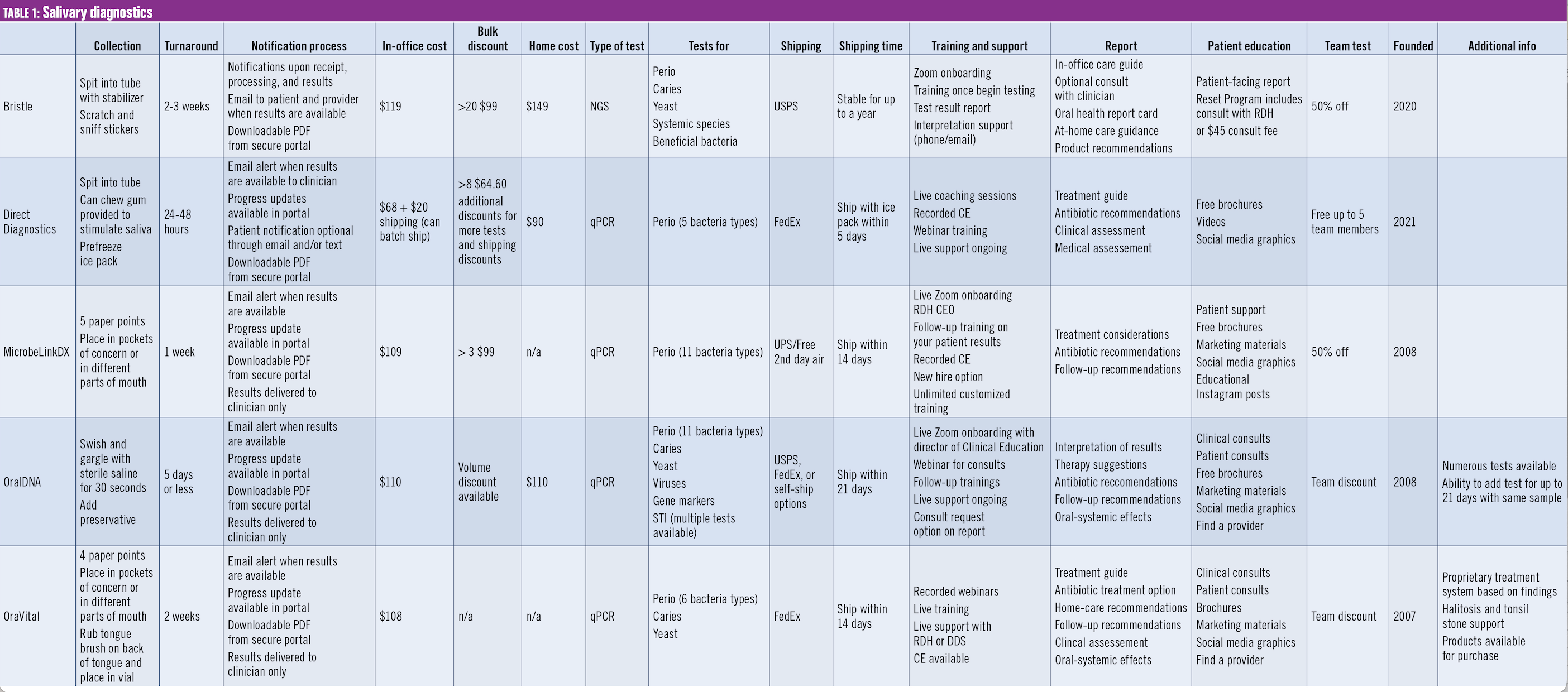
Clinicians and consumers often ask me, “What is the best oral microbiome test?” It’s a good question, considering the mouth’s vital role in overall health and the surge of new oral microbiome tests now available. I will lay out the most important criteria to consider when selecting an oral microbiome test for you or your patient. We will discuss the pros and cons of each test. I’ll explain how the the type of methodology used for an oral microbiome test impacts what microbes are measured and who it can help.
The oral microbiome, the collection of microorganisms living in the mouth, can give you a gorgeous mouth and fresh breath or it can set you up for cavities, tooth infections, and gum disease. It all depends on which microbes are in charge.
Can you test your microbiome? Absolutely. Tests can identify the bacteria in the mouth and how much are there. Most of these tests require a simple saliva specimen. For that reason, you’ll also see them referred to as salivary diagnostic tests. Follow-up testing can show if treatments have worked to change the microbes in the mouth for the better.
Oral microbiome testing will be a key clinical tool in the coming years for optimizing oral health and figuring out hard-to-solve oral diseases. While only clinicians have historically been able to run these tests, even consumers now have access to them.
We are grateful to our sponsors for making this blog possible: Terra & Co. and Riven.
Elevate your oral care routine with Terra & Co.’s holistic solutions, inspired by Ayurveda and crafted to nurture both your oral health and the environment. Our non-toxic, eco-conscious formulations—featuring hydroxyapatite, coconut oil, neem, and prebiotics—strengthen enamel, whiten teeth, and balance pH for long-lasting freshness, all while supporting a thriving oral microbiome.

Discover the first probiotic mouthwash, designed to work with your mouth’s natural balance. Riven’s probiotic formula supports a healthy microbiome, promoting long-term oral health without the need for harsh chemicals. It’s a science-backed solution with top-notch ingredients that works to keep your mouth healthy and thriving. Riven was founded by Dr. Fatima Khan, a passionate dentist on a mission to transform oral care with a science-driven approach. At Riven, we’re committed to providing effective, natural solutions that align with how the body truly works, ensuring healthier smiles for everyone. Use FRESH10 for 10% off at checkout.

Symptoms or Conditions that Can Benefit from Oral Microbiome Testing
- Alzheimer’s disease or dementia
- Bleeding gums
- Bad breath
- Burning tongue
- Cardiovascular disease (heart attack, stroke, high blood pressure)
- Chronic mouth or facial pain
- Chronic unexplained systemic illnesses like fatigue, autoimmune diseases, chemical sensitivity, and/or disability
- Diabetes
- Gum disease
- Gastrointestinal diseases
- Inflamed and swollen mouth tissues
- Oral health problems that don’t respond to usual dental treatments
- Rashes around the mouth
- Recurrent tooth decay
- Root canal infections
- Systemic inflammation
- Tooth extractions
- Tooth infections
- Ulcers and sores in the mouth
Testing the bacteria in your mouth is easy, convenient, and affordable. There are many different tests out there. Here are the main criteria to consider when choosing an oral microbiome test:
- Is the test geared to clinicians or consumers?
- Methodology- is it a quantitative or qualitative test?
- Why are you running the test?
- What does the test measure? Does it measure pathogens and how many? How many commensal bacteria (good bacteria) does it measure?
- What is the cost?
- Is it convenient to collect? What specimen is needed?
Is the test geared to clinicians or consumers?
Most oral microbiome tests available today are meant to be used by dental practitioners. That’s because they are seeing patients with gum disease. This type of test may focus on disease-causing mouth bacteria and treatments to kill them, especially to help resolve tough cases.
More recently, oral microbiome tests have come to market that can be ordered by consumers. These reports are easy to read and understand. They might measure a short list of pathogenic microbes or a long list detailing the whole microbiome.

Is the oral microbiome test quantitative or qualitative?
The type of technology used to run an oral microbiome test is critical to picking the right test. The methods influence what microbes are tested and how the results can be used. Yet most people, even practitioners, do not understand the differences. For clinicians who want a deeper understanding of the science, I review the testing methodologies in this article, “Technologies for Testing the Oral Microbiome.”
Oral microbiome tests can generally be divided into three types:
- Quantitative polymerase chain reaction (qPCR)
- Metagenomic sequencing
- Culture
The most advanced testing methods identify bacteria based on their DNA codes. These include PCR tests and metagenomic sequencing tests.
Quantitative PCR tests measure exactly how much microbial DNA is present in terms of the number of cells. qPCR is quantitative. qPCR tests usually measure a short list of pre-selected microbes and nothing more.
When you see results like this, you are seeing quantitative results measured with qPCR:
- 1.0 x 10E6 CFU/mL or
- 1.0 x 1,000 genomic copies/mL
Metagenomic sequencing tests are qualitative. They do not measure the number of bacterial cells, but instead provide a relative abundance. It essentially gives a percentage of total, or a piece of the pie. These tests can measure extremely long lists of microbes and show the relationships of microbes to each other in the microbiome.
Qualitative results from metagenomics tests are expressed as:
- % Relative abundance
As you can see, these methods both have advantages and disadvantages. You can get exact numbers of microbes, but it’s a short list. Or you can get percentages of a very long list of microbes without knowing exactly how much of a microbe is there. I overall prefer qPCR testing because quantitative results are something you can hang your hat on. But, most qPCR tests miss all of the key beneficial microbes.
Lastly, there are tests that culture the microbe, basically in a petri dish. This method was standard practice for many years. While some institutions may still use culture, it is now outdated and considered inaccurate compared to the newer DNA-based microbiome tests mentioned earlier.

Why are you running an oral microbiome test? How will you treat the findings?
Whether someone has oral disease or not influences what test to order.
To say it another way: are you looking to find and treat specific pathogens, or explore and balance the oral microbiome?
If someone has bleeding gums and is working with a practitioner, they will likely go for a shorter pathogens qPCR panel. For another person who has mild oral health symptoms, who wants to optimize the microbiome with home health care steps, a metagenomics test showing the full microbiome is a good choice.
What oral microbes are measured?
To pick the best oral microbiome test, you need to know what microbes the test measures. The bacteria in the mouth are divided into three major categories and not all oral microbiome tests measure them.
- Commensal– these good bacteria harmlessly coexist with us and often provide us with health benefits, such as fighting off pathogens.
- Opportunist– these common microbes may not cause problems. On the other hand, they can overgrow and cause disease when the circumstances are right, such as when you have a weakened immune system or disturbed microbiome.
- Pathogen– these bacteria are known to cause disease, but may be present in healthy people, too.
Oral microbiome tests may also measure viruses and/or fungi, such as Candida albicans.

Photo by National Cancer Institute on Unsplash
Does the oral microbiome panel measure pathogens and how many?
For those with an oral disease, testing for pathogens that are relevant to that disease are vitally important. Make sure the list of pathogens fits the clinical issue and is comprehensive enough. Opportunistic bacteria are often lumped into this category, too, since under certain conditions, they can also cause disease. The oral microbiome tests listed below measure anywhere from five to twenty-nine pathogens. Obviously, the more pathogens measured, the better. Both qPCR tests and metagenomics tests measure pathogens.
If you find pathogens on testing, how do you plan to treat them? When using invasive methods to control pathogens like antibiotics, scaling and root planning, quantitative results may be most helpful. When using more gentle, non-invasive methods at home to shift the microbiome or crowd out pathogens, qualitative results will give more information.
When there is oral disease, usually the focus is first on pathogens or opportunistic bacteria that may be causing it. However, tests that focus only on pathogens rarely measure commensal bacteria.
How many commensal bacteria (good bacteria) does the test measure?
Good bacteria are the missing part of the puzzle. It is the good bacteria in the mouth that help to keep pathogens under control and stop them from creating disease. For that reason, one way to get rid of pathogenic mouth bacteria is to simply crowd them out with good bacteria. Yet many clinicians are still targeting pathogens only, and overlooking commensals.
Likewise, most oral microbiome tests do not measure healthy mouth bacteria. That’s because oral microbiome tests have historically targeted only disease-causing pathogens, nothing else. When practitioners are giving killing treatments to address pathogens found on a qPCR test, they are in the dark as to what is happening with the patient’s good oral bacteria. They may be causing more harm than good.
Looking at the full oral ecology of the mouth and the spectrum of good bacteria is important if you want to build the oral microbiome to ward off disease, fight infections, promote fresh breath, and support cardiovascular health. Metagenomics testing does a great job with this.
If you have done qPCR testing for pathogens and it hasn’t helped bring about gum health, then qualitative testing is recommended. It can show more about the entire oral ecology- the good, the bad, and the ugly.
This is such an underappreciated area; we will likely see improvements in tests that measure good bacteria moving forward.
What is the cost?
The cost for an oral microbiome test ranges from about $100 – $259, depending on whether you are a practitioner or consumer (as of October 2024). However, if you’re a consumer working with a dentist, don’t be surprised if your costs in the clinic are higher than what is stated here. Practitioners get lower pricing from laboratories and they upcharge the tests in the office, which is a customary practice.

Is it easy to test mouth bacteria? What specimen is needed?
Most oral microbiome tests require only a saliva specimen, making it easy to collect. These saliva tests for oral bacteria can be shipped directly to your home. A couple of companies measure the microbiome around a specific tooth, or in a specific area of the mouth, using paperpoints. These oral tests looking at periodontal pockets must be administered by a dental professional.
Oral Microbiome Testing for Dental and Clinical Practice
It is a new world when managing oral health, now that we know about the oral microbiome. The older paradigm of killing all microbes in the mouth for perfect oral health has been proven less than effective, and even detrimental.
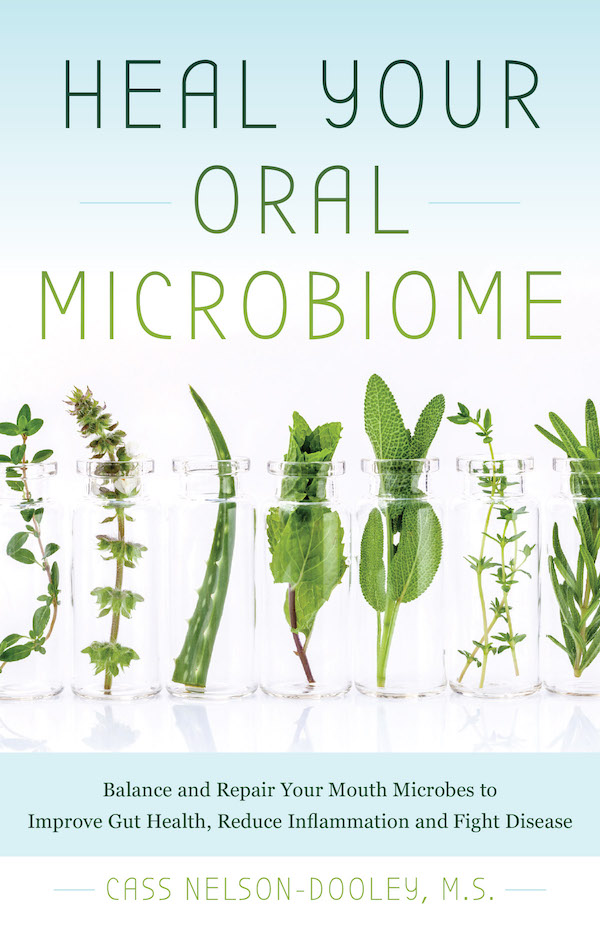
Dental practitioners now have to think about the good bacteria in the mouth, not just the pathogens. But old habits die hard. This is not an easy shift. It is not taught in dental schools or medical schools. Frankly, we are all learning how to manage the oral microbiome in a healthier way right now, as we speak. My book, Heal Your Oral Microbiome, was the first to do a thorough treatment of the topic.
qPCR Testing for Pathogens
Many clinicians are still thinking in terms of pathogens only. They are treating patients with oral diseases and looking for the responsible pathogens. In my view, quantitative results are better for measuring pathogenic microbes before and after clinical treatment because they are direct, quantifiable measurements.
For someone with bleeding gums or periodontal disease that doesn’t respond to the usual treatments, then a qPCR test is a good fit. When clinicians are using antibiotics or other aggressive killing methods to address oral dysbiosis, knowing the quantities of pathogens is important. If you have cavities, you will want to find an oral microbiome test that targets cavity-causing microbes. Knowing the precise quantities of bacteria can be helpful.

Metagenomics Testing for Health Optimization
Proponents of metagenomic sequencing point out that killing specific pathogens is an antiquated strategy. Rather, balancing the whole microbiome- commensals, opportunists, and pathogens -will lead to better long-term oral health. I fully agree with this philosophy. As we move forward, we will have to consider all of the players in the oral microbiome, not just a few select pathogens. Lasting oral health will likely revolve around a more comprehensive approach that reduces pathogens and builds up friendly bacteria.
The problem is that qualitative results for pathogens are not ideally suited to the clinical management of oral disease or monitoring aggressive treatments such as antibiotics. They do not quantify microbes.
There are many situations where metagenomics testing shines because it characterizes so many microbes that were previously hidden from view. For a healthy person who wants to optimize the oral microbiome, then a whole oral ecology metagenomics test is ideal. If you want to see if your microbiome is improving with natural treatments, this type of test is a good fit. If you are troubled with an unusual or hard-to-treat condition and you need to look at microbes that are not usually tested, a comprehensive test that looks at the whole oral microbiome may hold the answers.
Many dentists say that qualitative tests are useful for patients monitoring their home care and it helps patients get more invested in their oral health. When patients have been treated with many rounds of antibiotics and dental treatments, and still are not getting better, then it’s time to look at the rest of the oral microbiome with a metagenomics test. If their pathogens test looks “clean as a whistle,” but they are still having gum disease, cavities, or bad breath, then run a metagenomics panel.

The Best Oral Microbiome Tests
Ultimately, there is no single best oral microbiome test. That’s because none of them do it all. No single test quantifies pathogens, opportunists, and good bacteria in the mouth. In the meantime, I recommend taking the best from both worlds. I suggest ordering both a focused qPCR pathogens panel AND a comprehensive commensals panel using metagenomics, too.
For someone with gum disease for example, I would want a qPCR panel of pathogens from a company like OralDNA Labs alongside a panel measuring the full scope of the oral microbiome, like the Bristle Oral Health Test. Using them side by side, we can both quantify known pathogens and see the complex relationships of the full microbiome. The cost is still reasonable for both – under $430.
For people who cannot do both tests, I recommend a qPCR panel for gum disease, when treated and monitored by a practitioner. I recommend a metagenomics panel for optimizing oral health, or for stubborn chronic oral illnesses that no one can figure out.
Keep reading if you’d like to see the breakdown test by test.
Oral Microbiome Tests: The Breakdown
Testing the oral microbiome is easy, convenient, and there are many tests to choose from, especially if you are a practitioner.
Prices and descriptions of the tests are current as of Oct 2024, but things are changing quickly and you should check for pricing information with the laboratory. If you are a patient, the price you pay to your dental professional for an oral microbiome test will be higher than what is quoted in this article. Don’t be put off. In the clinic setting, it is customary for a clinician to upcharge the test to cover administrative fees, management of kits and ordering, and interpretation of the report.
For the following tests, I am mostly reviewing periodontal health panels. They are popular and widely available. However, if cavities (or caries) are the dental problem, some labs sell cavity microbiome panels, which measure a list of the microbes linked to cavities. Some labs carry oral virus tests and/or oral fungal tests. There are tests that can tell you about inflammation in the mouth.
Although I don’t cover these topics here, practitioners should check with the laboratories about treatment recommendations, the turnaround time, educational support, and how easy it is to compare a patient’s oral microbiome test results before and after treatment.
Let’s go through the different oral microbiome tests based on the criteria I think are most important: who the test is made for, are the results quantitative or qualitative (methodology), what pathogens are measured and how many, which commensals are tested (if any), the cost, and the specimen type.
Full disclosure: I have business relationships with some of the labs on this list and I consider them friends and colleagues. Nonetheless, I do my best here to give a balanced view of the oral microbiome tests, for both practitioners and consumers.

Oral Microbiome Tests for Both Consumers and Clinicians
Bristle $169 Consumer/ $120 Practitioner
Pros
- The Bristle Oral Health Test uses shotgun whole genome metagenomics, or metagenomic sequencing, to measure the ecology of the oral microbiome in its entirety. The test measures many, many friendly bacteria, opportunistic bacteria, and pathogens, as well as different species of fungi. One of the benefits of Bristle’s test is they measure Helicobacter pylori in the mouth, a topic I have written about extensively.
- They have a very patient-friendly report that connects the dots between certain microbes and symptoms so that everyone can understand. They also provide raw results.
- Both consumers and practitioners can order this test. Practitioners can get the test for $90-120.
Cons
- The Bristle Oral Health Test is a qualitative method. Results are presented as a % relative abundance, or a percent of the pie. Learn more about this in the article, “Technologies for Testing the Oral Microbiome.”
Peri $149
Pros
- The Peri Oral Health Test measures four of the most problematic periodontal pathogens with qPCR. It measures one cavity-causing pathogen, and two commensal bacteria (Streptococcus salivarius and Streptococcus parasanguinis).
- Consumers and clinicians can buy this test.
Cons
- This test misses out on other commensal bacteria, opportunistic, and pathogenic bacteria.
Viome $159-259
The Oral Health IntelligenceTM Test uses RNA technology, or metatranscriptomic sequencing. Since it measures RNA, it does not identify microbes, but rather the genes they express. They do not provide a sample report on their website. However, it is likely to be comprehensive, measuring many microbial functions as this is the strength of this type of technology. This test is available to consumers and clinicians.

Oral Microbiome Tests for Practitioners Only
Consumers, these prices are for practitioners only. Your prices for these tests in the dental or medical office will be higher than those quoted here.
OralDNA Labs $110
Pros
- MyPerioPath, a qPCR test, measures 11 pathogens known to affect oral health. OralDNA Labs, whose parent company is Access Genetics, was the first to test the oral microbiome in the United States. They have been around since 2008 and have a reputation with clinicians for science and quality. Their report showcases and explains the oral-systemic link. Patients may pay $169 – $199 in the office.
Cons
- The MyPerioPath test focuses only on eleven pathogens. It misses the commensal bacteria and other opportunistic bacteria.
- Only practitioners can order this test.
FidaLab $150
Pros
- The Periodontal Pathogens Test by FidaLab is a qPCR test using an oral rinse specimen. It measures 29 pathogens, making it a very long panel of pathogens.
Cons
- This test focuses only on pathogens. It misses commensal bacteria and opportunistic bacteria.
- Only practitioners can order this test.
Simply Test/Spectrum Solutions $90
Pros
- The Simply Perio test stands out from other oral microbiome tests because it gives a snapshot of bacteria, fungi, and viruses. It is a qPCR test of 12 oral pathogens and Candida albicans. It also measures one beneficial bacteria (Streptococcus sanguinis) and four viruses (Herpes simplex virus 1 & 2, cytomegalovirus, and Epstein Barr virus). This is a good sampling of bacteria, fungi, and viruses in one short test.
Cons
- This test misses out on commensal bacteria and opportunistic bacteria.
- Only practitioners can order this test.

US Biotek (Price Unavailable)
Pros
- The Oral Microbiome Mapping test measures eight pathogens, eight opportunistic bacteria, two fungal markers, and two normal bacteria. This is a nice snapshot of the oral microbiome using qPCR. It measures commensal bacteria Streptococcus salivarius and Lactobacillus species. It’s available with a saliva specimen or a swab specimen.
Cons
- This test misses out on other commensal bacteria.
- Only practitioners can order this test.
Microbe LinkDx $109
Pros
- The Microbe LinkDx test measures 11 microbes in the periodontal pockets. It is not a saliva test. With a paperpoint test like this one, clinicians zoom in to the microbiome in one specific area of the mouth or around one tooth. It is a quantitative PCR test, run by Access Genetics (see OralDNA Labs above).
Cons
- The Microbe LinkDx test misses the commensal bacteria and opportunistic bacteria.
- Only practitioners can order and administer this test.
OraVital $108
Pros
- The Biofilm DNA Analysis test by OraVital (Canada) is a test of the microbiome in the periodontal pockets. It requires paperpoints, which are inserted into the pockets around a tooth by a dentist as well as samples from the tongue and lip fold. This can help dental practitioners who are focused on oral disease around one tooth or in one small area of the mouth. It measures 8 pathogens involved in oral diseases. Here is a sample report.
- Though they are located in Canada, they do ship to providers in the US.
Cons
- This test misses out on commensal bacteria and opportunistic bacteria.
- Only practitioners can order this test.
Invivo £149 Pounds
For clinicians in the UK, the Oral EcologiX panel measures pathogens, opportunists, and Candida albicans. Results are reported as relative abundance, meaning that microbes are measured with metagenomic sequencing. Only clinicians can order this test.

Boost Oral and Whole Body Health with Oral Microbiome Testing
Oral microbiome testing is the way of the future. Testing and treating can help balance the oral microbiome and prevent not only oral diseases, but also diseases of the brain, cardiovascular system, and lungs, to name just a few. The best oral microbiome tests out there measure microbial DNA. Depending on whether you are a practitioner managing oral disease in your patients, or a consumer seeking to optimize oral health, the best test may be different. Oral microbiome tests differ in their methods, the number and variety of microbes they measure, and in the clinical utility of the results.
In someone who is struggling with gum disease, I recommend both a qPCR quantitative test focused on pathogens and a metagenomics qualitative test looking at the full spread of the oral microbiome, coming to less than $430 for both. This gives actionable information on pathogens, opportunists, AND commensals, which all need to be addressed in tandem when rebuilding the oral microbiome for optimum oral and systemic health.
Many thanks to the following colleagues and innovators in this field who helped with my research for this article: Brian Maurer, Shannon Thorsteinson, DMD, Debbie Ozment, DDS, MS, Diane Larson, RDH, BSDH and Barbara Tritz, RDH.


Cass Nelson-Dooley, MS, is a researcher, author, educator, and laboratory consultant. She studied medicinal plants in the rain forests of Panama as a Fulbright Scholar and then launched a career in science and natural medicine. Early on, she studied ethnobotany, ethnopharmacology, and drug discovery at the University of Georgia and AptoTec, Inc. She joined innovators at Metametrix Clinical Laboratory as a medical education consultant helping clinicians use integrative and functional laboratory results in clinical practice. She owns Health First Consulting, LLC, a medical communications company with the mission to improve human health using the written word. Ms. Nelson-Dooley is an oral microbiome expert and author of Heal Your Oral Microbiome. She was a contributing author in Laboratory Evaluations for Integrative and Functional Medicine and Case Studies in Integrative and Functional Medicine. She has published case studies, book chapters, and journal articles about the oral microbiome, natural medicine, nutrition, laboratory testing, obesity, and osteoporosis.